Commitments, resolved on the record.
Typed resolution. Typed continuation. Computable open commitments. Aura renders civic discourse as a typed substrate where institutional speech carries structural weight and the audit is the platform.
Section 1 · Accountability continuity
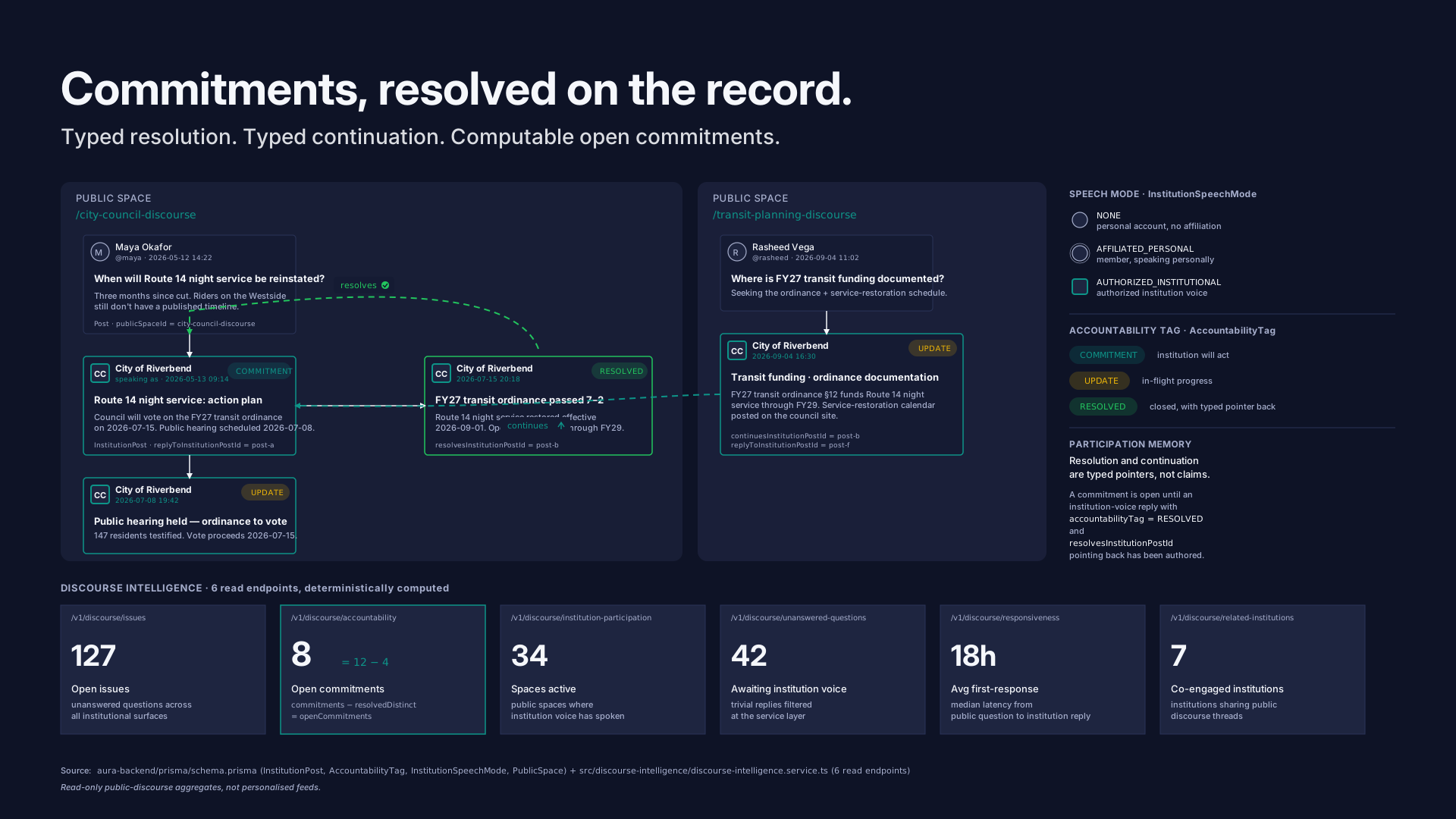
An institution-voice reply tagged RESOLVED with a typed pointer back to the commitment.
When the institution speaks, the substrate records what it committed to. When the commitment is met, a later reply carries accountabilityTag = RESOLVED and resolvesInstitutionPostId pointing back. The substrate records closure as a typed graph edge — not as an editorial claim.
Three accountability tags
- COMMITMENTInstitution will act
- UPDATEIn-flight progress on a prior commitment
- RESOLVEDClosed; with typed pointer back to the original commitment
Why typed
A commitment that exists as styled text inside a feed decays. The substrate's typed pointers (resolvesInstitutionPostId) make resolution structural. A reader two years later can trace what the institution committed to, what updated, what closed.
Only AUTHORIZED_INSTITUTIONAL speech can carry an accountability tag. Personal users cannot tag commitments on behalf of an institution. The schema enforces this.
aura-backend/prisma/schema.prisma (InstitutionPost, AccountabilityTag)
Section 2 · Institutional participation
Three speech modes. The institution speaks; the user is subscript.
InstitutionSpeechMode is typed substrate. A single account can speak as a personal user, as an affiliated member of an institution (disclosed), or as the authorized voice of the institution itself. The mode is per-post, not per-account.
The three modes
- NONEPersonal account; no institutional affiliation
- AFFILIATED_PERSONALMember of an institution, speaking personally — affiliation disclosed
- AUTHORIZED_INSTITUTIONALAuthorized to speak as the institution's voice
When the mode is AUTHORIZED_INSTITUTIONAL, the visual rendering places the institution avatar primary and the user avatar as subscript. The substrate's hierarchy is the visible hierarchy. The institution is the speaker; the user is the channel through which the institution spoke at that moment.
This is structural, not stylistic. A regulated-sector communications director rendering an official statement gets institutional substrate weight automatically — and a later reader can verify who authored on whose authority through the schema.
Section 3 · Public ↔ institution governance
Continuation crosses public space boundaries.
A commitment posted in one public space (City Council Discourse) may be substantively continued months later in another (Transit Planning Discourse). The substrate's continuesInstitutionPostId pointer makes this typed and traceable across thread, space, and time.
Cross-thread memory is typed substrate, not metadata. A reader walking the graph from a new post can follow continues edges backward to the originating commitment, regardless of which public space the discussion has moved into.
This matters institutionally. Civic accountability frequently crosses contexts — a commitment in a council session is continued in a transit planning session is updated in a public hearing. The substrate makes this walkable.
Public space hosts
Each PublicSpace is a discourse host with its own slug, name, status, and display order. Posts opt-in to a space; replies inherit the parent's space. The substrate's graph crosses spaces explicitly through typed pointers — not implicitly through search or recommendation algorithms.
Read-only public-discourse aggregates, not personalised feeds.
aura-backend/prisma/schema.prisma (PublicSpace, InstitutionPost.continuesInstitutionPostId)
Section 4 · Persistent civic memory
Open commitments compute deterministically. Anyone can audit.
Discourse intelligence is six read-only aggregates surfaced through DiscourseIntelligenceService. The most-quoted aggregate — open commitments — is a deterministic computation: commitments − resolvedDistinct = openCommitments.
/v1/discourse/issues
127
Open issues
Unanswered questions across all institutional surfaces.
/v1/discourse/accountability
8
= 12 − 4 (commitments − resolvedDistinct)
Open commitments
Deterministic computation. Anyone can audit.
/v1/discourse/institution-participation
34
Spaces active
Public spaces where institution voice has substantively spoken.
/v1/discourse/unanswered-questions
42
Awaiting institution voice
Trivial replies filtered at the service layer.
/v1/discourse/responsiveness
18h
Avg first-response
Median latency from public question to institutional reply.
/v1/discourse/related-institutions
7
Co-engaged institutions
Institutions sharing public discourse threads.
aura-backend/src/discourse-intelligence/discourse-intelligence.service.ts
Section 5 · Discourse lineage
Posts connect to posts through typed pointers. The graph is the audit trail.
Aura's substrate is a graph, not a feed. replyToInstitutionPostId creates the reply tree. resolvesInstitutionPostId creates resolution edges across the graph. continuesInstitutionPostId creates continuation edges across public spaces. The graph is the substrate's history rendered as walkable structure.
A reader interested in what a specific institution committed to during a specific year walks the graph: filter InstitutionPost by institution, by date, by accountabilityTag = COMMITMENT. For each commitment, follow forward to its resolves edges. The result is a substantive answer to a substantive civic question — without aggregation lies, without algorithmic curation, without engagement reranking.
This is the substantive difference from social-network substrate. Social networks rank for engagement; substantive truth and high-engagement content correlate poorly. Aura's substrate ranks for nothing — the graph is the surface. Discourse intelligence aggregates the graph; it doesn't curate it.
Section 6 · Historical continuity
Commitments persist until resolved. UPDATE and RESOLVED are typed, not editorial.
In social-network substrate, a post posted today is gone from the feed in 72 hours. In civic-record substrate, a commitment posted today remains an open commitment until a typed RESOLVED reply with a pointer back has been authored.
The substrate doesn't decay commitments on a time horizon. A commitment from 2024 is the same substrate fact as a commitment from this week. The institutional accountability arc is durable in a way feeds aren't.
This is the institutional reason civic governments, public agencies, regulatory bodies, mission-aligned nonprofits, and academic institutions choose this substrate over social-network platforms: the substrate serves the civic function their institutional mandate requires. The engagement-substrate platforms cannot.
Section 7 · Institutional correspondence
The same fingerprint shapes civic discourse and revenue execution.
Aura and Orchestrate share one architectural fingerprint. Two products. One conviction. The substrate is the moat.
company/visuals/flagship/direction/CG-01-architectural-fingerprint.md
Discourse canon
Read the substrate.
Every claim on this page traces to real backend code. The discourse canon documents the substrate openly.